
Golf Tips
Iona Stephen's Ball Striking Lesson: Build Better Iron Contact
Iona Stephen's ball striking lesson connects her TPI context, thin-iron pattern, fade intention and ground-line drill to show…

Most golfers are not short of effort. They go to the range, work on a swing thought, hit balls, and try to make the move feel different. The problem is that effort without feedback can quickly become guesswork.
That is exactly where Swing Coach can help. In a lesson, a golfer gets feedback on every shot. A coach can see whether the movement improved, whether the old pattern came back, and what needs to change next. Take that same golfer away from the lesson tee, and the feedback loop often disappears. The swing may feel different, but the camera or ball flight can tell a different story.

Swing Coach gives golfers instant feedback during practice, and the example here is a common one: fixing an over-the-top, steep downswing by checking where the club is halfway down in the downswing.
The point is simple: a lot of golfers are practicing, but they are not always getting clear information about what actually changed.
You may recognise the pattern. You have a good lesson, make progress while the coach is there, then struggle to keep the same move when you practise on your own. In the lesson, the feedback is constant. The coach can tell you whether the swing changed, whether the ball flight matched the intention, and whether your feel is moving you closer to the goal.
On the range by yourself, it is different. You might be working on the right thing, but you are relying heavily on feel, ball flight, memory, and hope. That can work sometimes, but it is also why golfers often say things like:
That gap is where golf swing feedback becomes useful. It gives you something more objective than feel alone. It does not replace good coaching, and it does not mean every swing problem is solved automatically. But it can make practice much more purposeful because you can connect what you felt with what actually happened.
Swing Coach is an AI golf swing app built around quick practice feedback. It is not just about recording a swing. It is about using the feedback to guide the next rep.

The setup uses the down-the-line camera view. That is the view from behind the golfer, looking down the target line. For the fault they are working on, that angle is important because it helps show the club’s relationship to the swing plane during the downswing.
The specific checkpoint is “half down”. That means the club is roughly halfway down in the downswing, before impact. For many slicers or golfers who come over the top, this is where the club can get too steep and move outside the desired path.
The setup is practical:
That setup matters because the feedback is only useful if the capture is consistent enough to measure what you are trying to measure. If the camera is in the wrong place, you can end up judging the swing from a poor angle. The app setup is part of the practice process, not just a technical detail.
The fault being worked on is an over-the-top, steep downswing. In plain English, that usually means the club moves too much from outside the target line as it starts down toward the ball. The club can get steep, the path can cut across the ball, and the golfer often sees a pull, fade, or slice pattern.
Not every slice comes from exactly the same cause, and not every steep downswing looks identical. But the pattern is familiar: the golfer is trying to change the downswing, and they need feedback to know where the club actually is halfway down.
The first measured swing gives the starting point: “club at half down, steep by five.”
Swing Coach gives a number between 1 and 10 in relation to the measurement being worked on. The lower the number, the closer the golfer is to the desired zone. A five means the club is noticeably outside the preferred range for that checkpoint.

The useful part is not simply that the app labels a swing good or bad. It identifies the specific issue being measured. In this case, the club is steep at half down. That gives the golfer a clearer practice target than simply trying to “swing better” or “stop slicing”.

The visual feedback also makes the fault easier to understand. When the club is in the red danger zone, the golfer can see the relationship between the swing plane and the measured position.
Once the app shows the starting point, the next job is not to hit more balls with the same pattern. The golfer needs to create a different feel.
The drill guidance can then be used from within Swing Coach. The focus is on shallowing the club more in the downswing. That means the golfer is trying to get the club working less steeply as it comes down.

Here is the important coaching point: when a golfer has been steep for a long time, a small change may not be enough. What feels neutral to the golfer may still be steep on camera. That is why the opposite feel often needs to be exaggerated.
They are not trying to hit a perfect shot immediately. They are trying to help the golfer experience what it feels like to be clearly on the shallow side in a practice swing. That practice swing comes back as “shallow by three”.
This is the heart of feel vs real golf swing work. A golfer might say, “I feel like I am swinging from the inside.” Without feedback, they have to trust that feeling. With feedback, they can find out whether that feeling produced the intended change.
That does not mean the golfer should chase a number for its own sake. It means the golfer can calibrate their feel. If a practice swing feels massively shallow and the feedback says it is only slightly shallow, that tells the golfer something useful. If a ball swing feels improved but still comes back steep, that tells the golfer something useful too.
Now each swing has a job. It is not just another ball hit on the range. It is a chance to match the feel to the reality.
The most useful part is the progression. The golfer does not go from steep by five to perfect with one swing. That would be the wrong lesson to take.
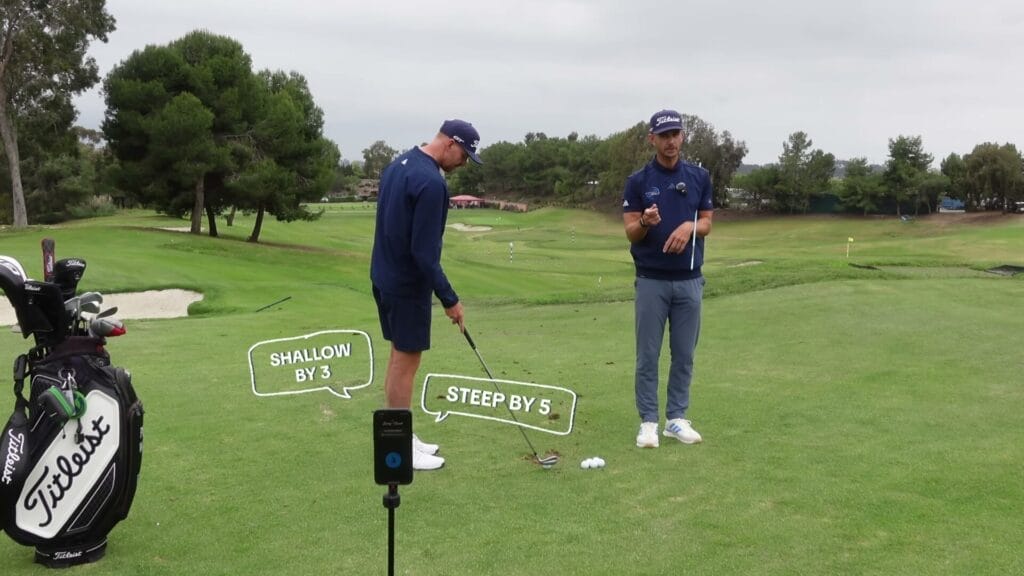
Instead, the pattern looks more realistic:
That is a healthier model for practice than expecting instant perfection. The point is progress with information.
If you are trying to fix an over-the-top golf swing, you need to know whether the club is still coming down steeply. If you are trying to shallow the club, you need to know whether the new feel is producing a real change. If you are hitting balls and guessing, you can easily spend a session reinforcing the old move.
One of the most important coaching observations here is that the practice swing can look dramatically different from the ball swing. That is true for a lot of golfers. Put a ball down and the body often returns to the movement pattern it knows best, especially when the golfer is trying to make contact and control direction.

That is why feedback between swings is so valuable. It helps the golfer make small adjustments:

This is where AI golf swing analysis can be most useful for a practice golfer. The benefit is not endless data. The benefit is getting the right piece of feedback quickly enough to shape the next rep.
The risk with any golf swing analysis app is that golfers can start chasing too much information. If every metric becomes a new swing thought, practice gets messy very quickly.
The better approach is to use feedback around one clear priority.
For this feedback session, the priority is the club at half down in the down-the-line view. That is enough. The golfer is not trying to rebuild the entire swing in one session. They are trying to understand whether the club is too steep and whether the shallow feel is moving the swing closer to the desired zone.
If you are using golf swing feedback in your own practice, keep the session simple:
This is where the app can support coaching rather than replace it. A coach can help you choose the right priority and drill. Feedback can then help you practice that priority more effectively between lessons.
Golf swing feedback is information that tells you what actually happened in the swing. It might come from a coach, video, a launch monitor, ball flight, or an app. The key is that it gives you something more reliable than feel alone.
AI golf swing analysis can help identify and track parts of the movement, such as whether the club is steep at a certain point in the downswing. That can make practice more focused. It still works best when paired with a clear drill and a specific swing priority.
When there is no ball, it is usually easier to make an exaggerated new movement. Once the ball is there, your normal coordination can take over because you are trying to make contact and control the shot. That is why feel vs real feedback is useful: it shows whether the change survived when you hit the ball.
Start with one measurable priority. A useful starting focus is the club at half down from the down-the-line view. For many golfers, a coach or structured app feedback can help decide whether that is the right checkpoint for their swing.
Practicing harder only helps if you know whether the practice is changing the swing. If you want to try the feedback approach shown in the video, use the link below to test Swing Coach free for two weeks.

Iona Stephen's ball striking lesson connects her TPI context, thin-iron pattern, fade intention and ground-line drill to show…

Trying to hit your driver perfectly straight can make misses harder to manage. Learn how to choose a…

Topping fairway woods often comes from trying to sweep them like a driver. Learn the low-point, setup and…
FIND YOUR COACHING PLAn
Take Our 90-Second Quiz To Get Your Personalised Coaching Roadmap
Unlock your personalised plan
See results on the course, fast
4.9/5 from 1,200+ golfers


